SEX DIFFERENCES IN OPIOID-SPARING ANALGESIA: INSIGHTS FROM THE TOWARD OPIOID FREE AMBULATORY SURGERY (TOFAS) PROGRAM
Sidhant Kalsotra1, William Taylor Head1, Divyaam Satija1, Stefanie C Rohde1, Savannah Renshaw1, Benjamin Poulose11. General and Gastrointestinal Surgery, The Ohio State University Wexner Medical Center, Columbus, OH, United States.
Introduction: Sex-based differences in pain perception may influence outcomes of opioid-sparing protocols. We evaluated sex differences in postoperative pain, psychological factors, and opioid utilization in patients receiving the Toward Opioid Free Ambulatory Surgery (TOFAS) protocol to assess whether sex affects clinical outcomes and opioid requirements after ambulatory surgery.
Methods: Single-center prospective cohort study (2021-2024) of adults undergoing ambulatory general surgery procedures. TOFAS protocol consisted of ibuprofen 600mg alternating with acetaminophen 650mg every 3 hours for 36 hours, with oxycodone 5mg rescue (10 doses) as needed. Regional/operative blocks were performed when appropriate. Validated surveys assessed pain intensity (0-10), Pain Catastrophizing Scale, Brief COPE, and satisfaction. Comparisons used Mann-Whitney U and Fisher's exact tests.
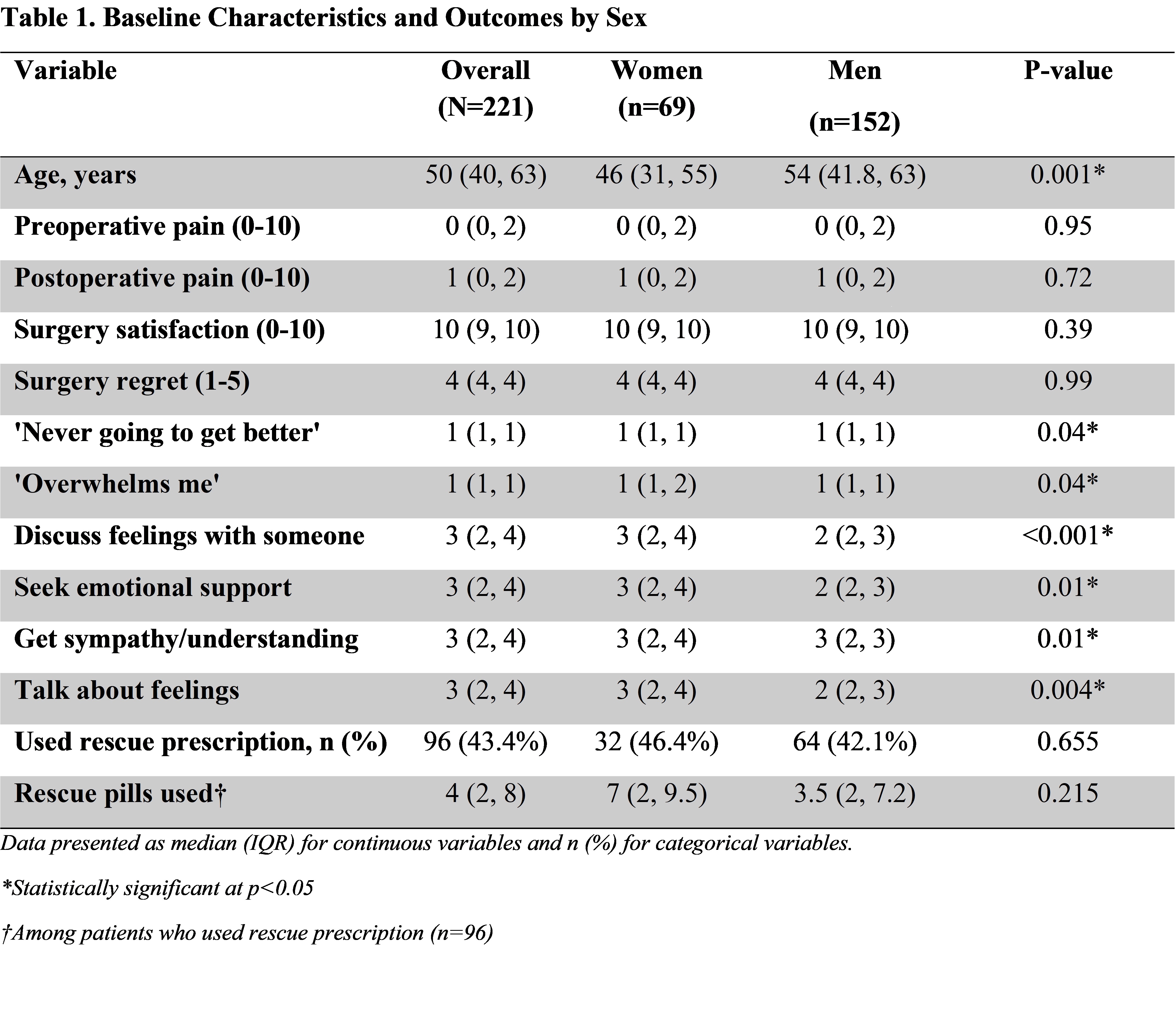
Results: Among 221 patients (69 women [31.2%], 152 men [68.8%]), women were younger (median 46 vs 54 years, p=0.001). Despite demographic differences, postoperative pain scores were equivalent (median 1 [IQR 0-2] for both, p=0.72), as were satisfaction (median 10 [IQR 9-10], p=0.398) and regret scores (median 4 [IQR 4-4], p=0.992). However, women demonstrated higher pain catastrophizing on two items ("never going to get better" and "overwhelms me," both p<0.05) and greater emotional support-seeking (discussing feelings p<0.001; seeking support p=0.01; getting sympathy p=0.011; talking about feelings p=0.004). Rescue opioid utilization rates were similar (46.4% women vs 42.1% men, p=0.655). Among rescue medication users, women consumed nearly double the pills (median 7 vs 3.5), though not statistically significant (p=0.215).
Conclusions: TOFAS protocol achieved equivalent pain control and satisfaction across sexes. Despite significant sex differences in pain catastrophizing and coping mechanisms, these psychological factors did not translate to differences in pain scores or satisfaction. However, the clinically meaningful trend toward higher rescue opioid consumption among women warrants investigation in larger studies. While standardized opioid-sparing protocols are effective across sexes, clinicians should remain aware of potential sex-specific analgesic needs for breakthrough pain management.
Back to 2026 Abstracts