HIGH FIBER PREHABILITATION RESCUES DIET INDUCED ANASTOMOTIC LEAK IN MICE
Mohsen Rouhani Ravari2, James Bradford2, Andrea D. Olivas2, Kristina Martinez-Guryn1, Orlando DeLeon2, Benjamin Daniel Shogan21. Midwestern University - Downers Grove Campus, Downers Grove, IL, United States.
2. The University of Chicago, Chicago, IL, United States.
Introduction: Anastomotic leakage is a devastating complication after colorectal surgery. Our lab has shown that a high-fat/no-fiber diet impairs anastomotic healing. How dietary prehab can prevent diet induced anastomotic leak remains unknown. We hypothesize that, in a murine model of colon surgery, dietary prehab with a high-fiber/low-fat diet rescues anastomotic healing impaired by a high-fat/no-fiber diet by altering transcriptional pathways.
Methods: C57BL/6 mice were fed either a high-fat/no-fiber diet or a high-fiber/low-fat diet for 12 weeks prior to surgery. In the third cohort, mice were fed a high-fat/no-fiber diet for 6 weeks and then switched to a high-fiber/low-fat diet (Prehab) before a distal colon resection and anastomosis. Mice were sacrificed on postoperative day (POD) 7 to assess Anastomotic Healing Score (AHS) and histology, and on POD3 to perform single-cell RNA sequencing (scRNA-seq) of the peri-anastomotic epithelium.
Results: Upon sacrifice on POD7, high-fat/no-fiber fed mice demonstrated worst anastomotic healing compared to high-fiber/low-fat fed mice (AHS [higher is worse healing] mean ± SD: 3.2±0.4 vs. 0.6±0.5; p<0.0001) (Fig1). Prehabed mice were rescued from anastomotic leak and exhibited healing comparable to mice maintained on high-fiber/low-fat diet for the entire 12 weeks (1.3±0.9 vs. 0.6±0.5; p= 0.07). Histology confirmed that both high-fiber/low-fat fed and Prehab mice exhibited complete healing characterized by no inflammation, preserved muscularis propria, fibroblast proliferation, and no abscesses, whereas high-fat/no-fiber-fed mice showed severe transmural inflammation, muscularis propria necrosis, and abscess formation. To resolve these cellular differences, scRNA-seq was performed on peri-anastomotic tissue (Fig2). Mature and immature colonocytes in high-fiber/low-fat and Prehab cohorts revealed increased frequency and expression of genes associated with epithelial healing and colonic differentiation (Aqp8, Aqp4, Sult1a, Car1, Muc2, Gpa33, Satb2) compared with high-fat/no-fiber fed counterparts. In these groups, colonocytes displayed upregulation of TCA cycle enzymes and featured Sis+ subpopulations not typically found in the colon. These changes are indicative of a metabolically active and proliferative state, which was absent in high-fat/no-fiber fed mice. Furthermore, goblet cells in high-fat/no-fiber fed mice aberrantly expressed Lyz1, suggestive of a transdifferentiated phenotype, mirroring those reported in inflammatory, poorly healing conditions such as ulcerative colitis.
Conclusion: High-fiber/low-fat prehab rescues diet induced anastomotic healing by transcriptional reprogramming of colonocytes toward a metabolically active and proliferative state. These findings highlight the potential of dietary prehabilitation as a practical strategy to prevent anastomotic leak and its mechanistic underpinnings.
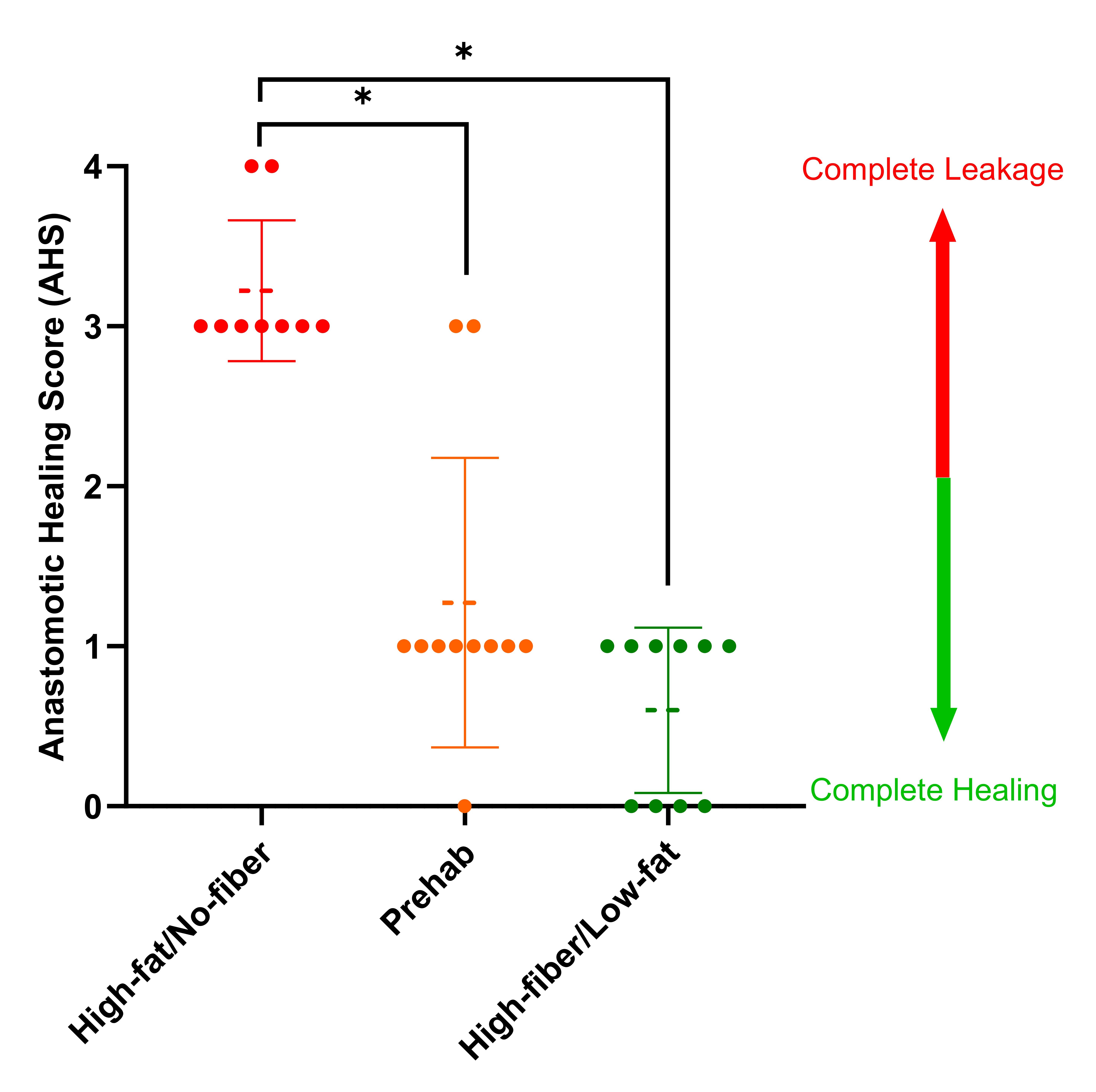 Figure 1. Anastomotic Healing Score (AHS) in high-fat/no-fiber, Prehab, and high-fiber/low-fat fed mice on POD7. Each dot represents an individual mouse; bars indicate mean ± SD; two-tailed Student's t-test; P < 0.0005. Scoring criteria: 0 - normal healing; 1. Flimsy adhesions; 2. Dense adhesions without abscess or intraperitoneal contamination; 3. Dense adhesions with gross abscess at the anastomotic site; 4. Gross leak with peritoneal contamination and visible anastomotic dehiscence.
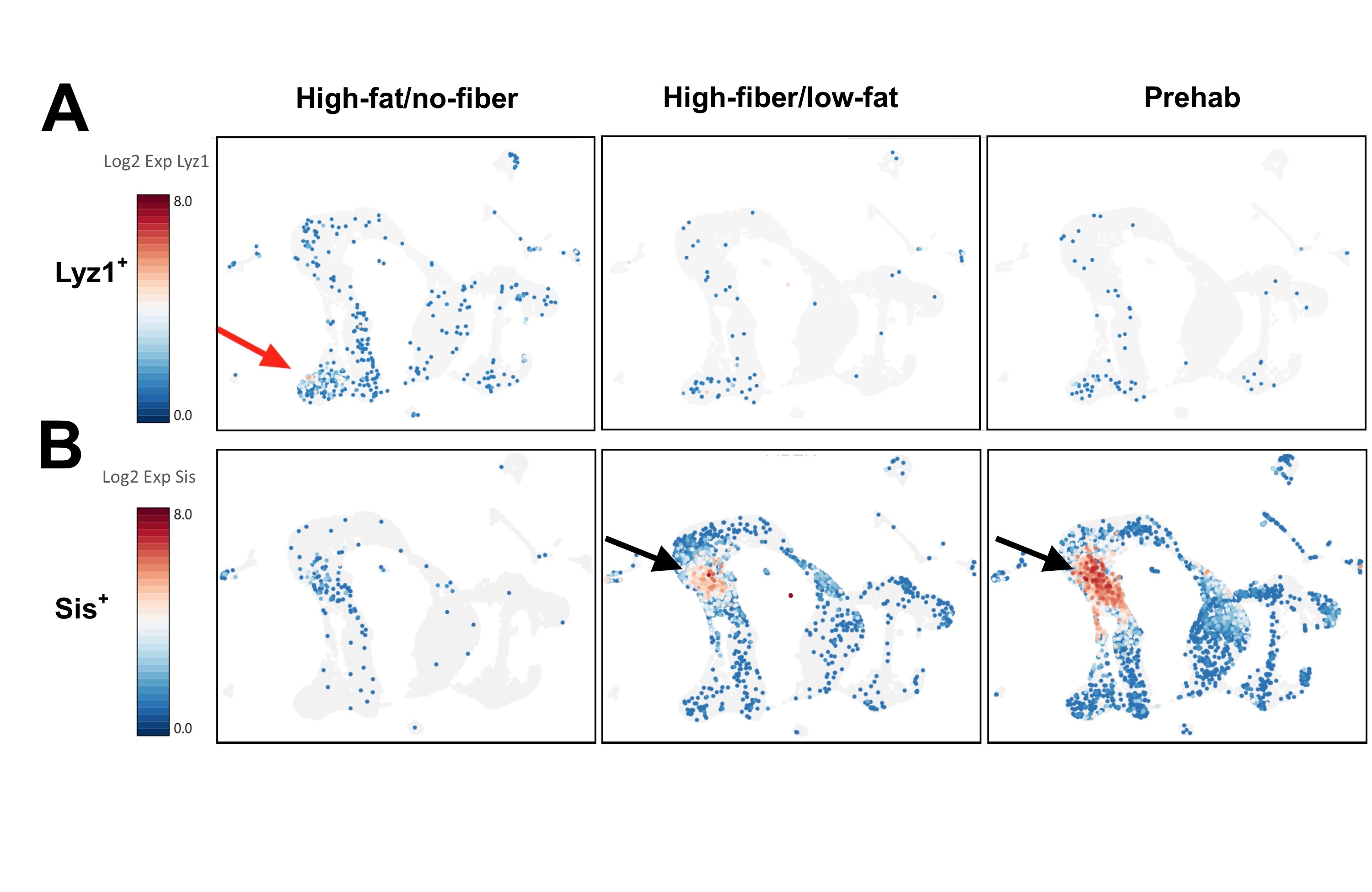 Figure 2. Diet-driven transcriptional reprogramming of peri-anastomotic epithelial cells reveals (A) emergence of goblet cells aberrantly expressing Lyz1 (red arrow) in high-fat/no-fiber diet and (B) appearance of a Sis-positive subpopulation (black arrows) in high-fiber/low-fat and Prehab fed mice.
IMAGE CAPTION: Figure 1. Anastomotic Healing Score (AHS) in high-fat/no-fiber, Prehab, and high-fiber/low-fat fed mice on POD7. Each dot represents an individual mouse; bars indicate mean ± SD; two-tailed Student's t-test; P < 0.0005. Scoring criteria: 0 - normal healing; 1. Flimsy adhesions; 2. Dense adhesions without abscess or intraperitoneal contamination; 3. Dense adhesions with gross abscess at the anastomotic site; 4. Gross leak with peritoneal contamination and visible anastomotic dehiscence.
Figure 2. Diet-driven transcriptional reprogramming of peri-anastomotic epithelial cells reveals (A) emergence of goblet cells aberrantly expressing Lyz1 (red arrow) in high-fat/no-fiber diet and (B) appearance of a Sis-positive subpopulation (black arrows) in high-fiber/low-fat and Prehab fed mice.
Back to 2026 Abstracts